
Can we talk about the elephant in the meeting room?
How many client presentations technically include all the right information…
…and still don’t really do the job. (AKA get the dang client)
I know you know what I’m talking about.
→ Forty-seven bullet points.
→ A market stat that appears suddenly with no context.
→ A slide titled “The Process” that somehow makes the process feel less clear.
→ A testimonial wall at the end that feels like, “Before you leave, please enjoy these strangers saying I’m competent.”
I’m not judging. We have all made the overstuffed slide deck.
I also deeply feel the need to be honest with you, and admit I’m SO not the person who gives presentations every Tuesday in a fitted blazer and headset mic.
But I have spent years creating courses, templates, trainings, and educational resources for real estate agents — the kind they actually use.
And the biggest thing I’ve learned is this:
A great presentation doesn’t prove you know everything. It helps your client understand what they need to know to choose you confidently.
Your potential client probably doesn’t need every possible detail about inspections, financing, contingencies, market shifts, appraisal gaps, negotiations, agency agreements, and closing timelines all thrown at them in one sitting like a real estate confetti cannon.
They need:
√ Orientation.
√ Context.
√ To know where they are, what matters now, what can wait, and what happens next.
So if you’re struggling to put together a killer client presentation, here are my top three tips.
1. Give Them a Map
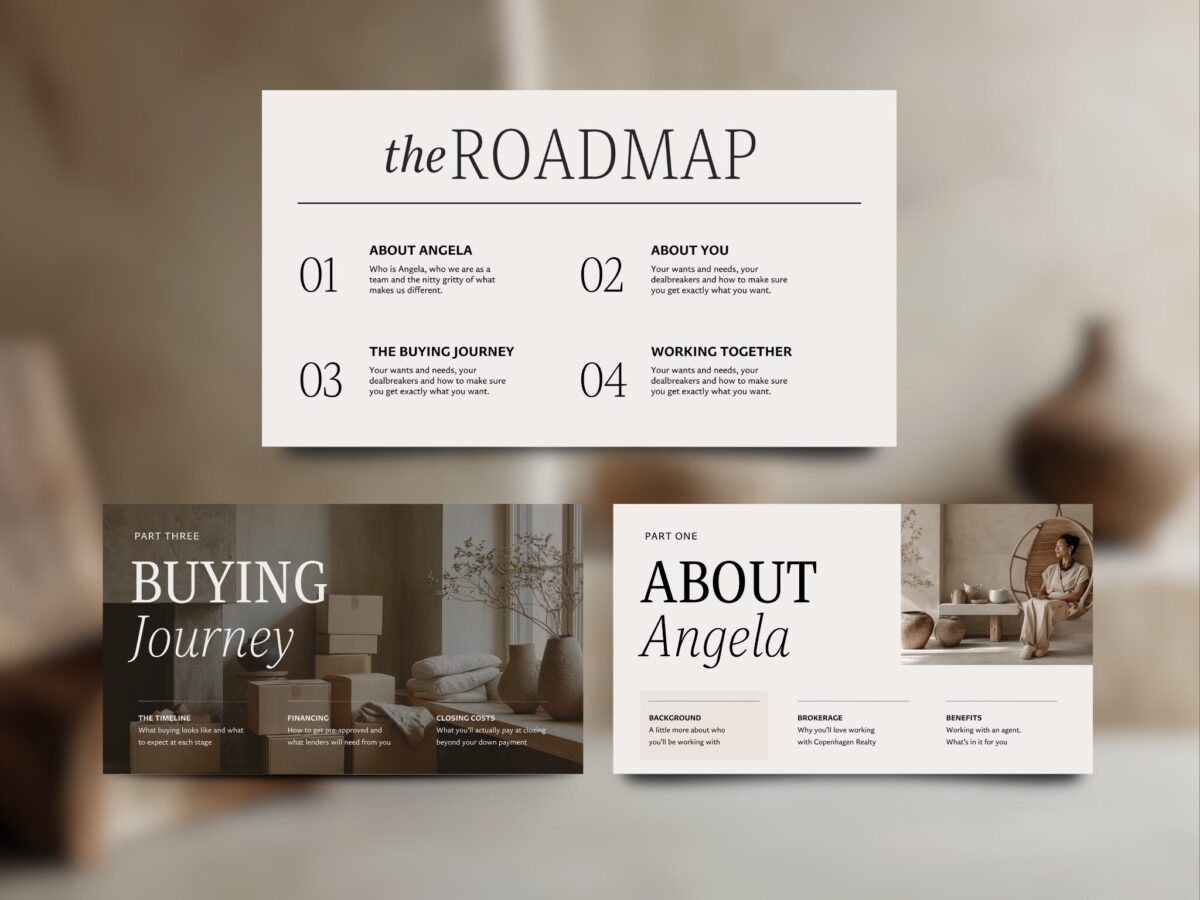
The worst thing a presentation can do is not tell your viewer where you’re headed.
If you’ve ever sat through a presentation without a clear structure — not knowing when this bloody thing would end — you know exactly what I’m talking about.
Show them upfront: “Today we’re covering three things: who you’re working with, what’s happening in the market, and what the buying process looks like.”
Now they can relax. They know where they are and what’s coming.
But here’s the key: don’t just show them the roadmap at the beginning and disappear into the slides. Keep reminding them where you are throughout. These little check-ins keep them oriented. They know where they are, what’s coming, and no one is quietly trying to determine whether “my dog just threw up” is a believable exit strategy.
2. Serve Them the Appetizer, Not the Entire Buffet
This is the biggest mistake I see: trying to include every single detail about every single step because you want to prove you’re thorough.
I get it. You are thorough. You care.
But a buyer presentation should be dipping their toe into the pool — not asking them to put on their scuba gear and get ready for a two-hour deep dive.
You don’t need to explain every possible scenario, every financing option, every type of inspection, every market condition that could possibly arise.
You need to give them the overview. The lay of the land. The “here’s what matters most and what you need to know right now.”
Save the deep dives for when they actually come up. Your job in the presentation is to build trust and clarity, not to overwhelm them with information they can’t possibly absorb in one sitting.
Less is more. Always.

3. Say No to the Testimonial Dump (Do This Instead)
This is my biggest, best tip for incorporating social proof into your presentation.
After each section, include a story about how one of your clients experienced a win relating to that section.
Just explained your credentials and what makes you different? Show a testimonial from a client who said working with you felt more like having a friend in their corner than hiring a realtor.
Just walked through your negotiation strategy? Share a story about the buyer who saved $20K because you fought for them.
Don’t be afraid to pull specific sections of testimonials that help prove your points. Weave them in where they’re relevant, not all stacked at the end like a testimonial wall that feels like, “Before you leave, please enjoy these strangers saying I’m competent.”

Your presentation should guide, educate, and gently nudge — not pitch. Get those three things right and the yes takes care of itself.
Grab the Copenhagen Buyer + Seller Presentation HERE.






FIND ME HERE
@theMelanieGrey
If you’re into honest business advice, introvert-friendly marketing, and the occasional mildly unhinged creative rant...
you’ll love it here.
Instagram
FOLLow
Pinterest
ADD
Journal
READ
YouTube
WATCH